
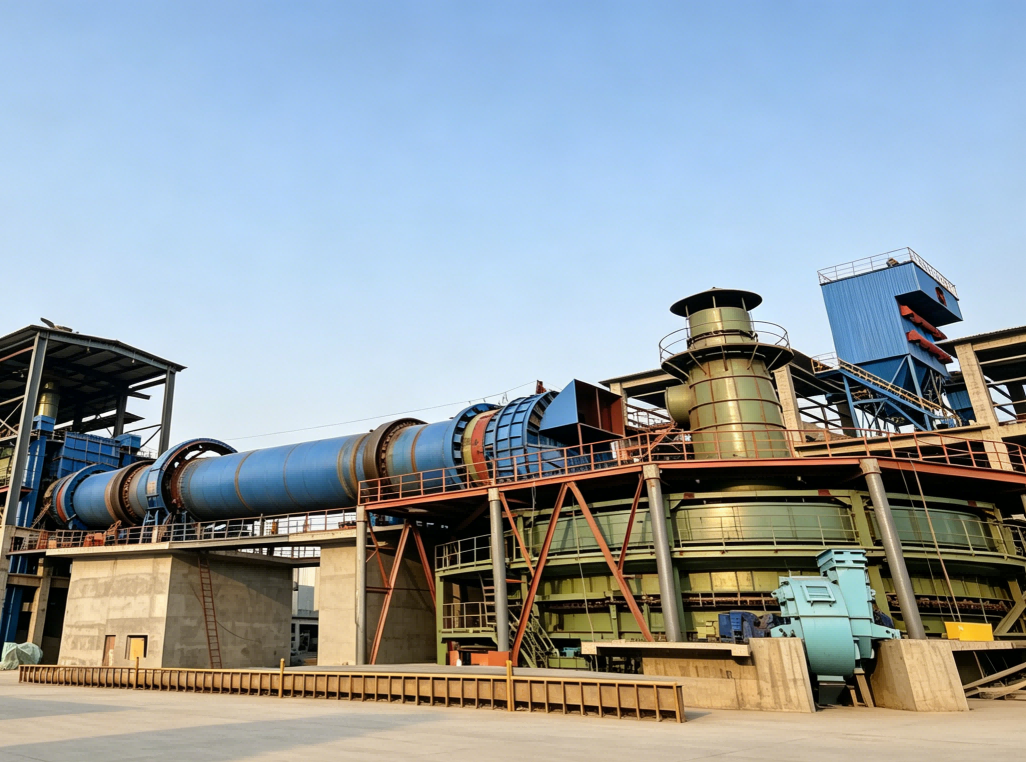
Grate-Kiln Iron Ore Pelletizing Line, 340–350 t/h – Brazil
Project Overview
340–350 t/h iron ore pelletizing line in Brazil: traveling grate, rotary kiln and cooler system with wear-resistant internals for a large iron ore company.
Customer & Feedstock
The customer is a large Brazilian iron ore processing company. Pelletizing converts fine comminuted ore — the fraction too fine for the concentrate stream — into fired pellets that can be shipped, used in blast furnaces, or fed to DRI. At the customer's scale, the pellet plant is a core asset, not an auxiliary: downtime directly moves export figures.
Feed to the plant is iron ore fines below the pelletizing cut (typically −750 µm), bonded with a small amount of binder (typically 0.5–2 % bentonite). Finished pellet strength and chemistry are set by the customer's offtake specifications.
Challenges & Requirements
- Energy at scale. At 340–350 t/h the pellet plant is one of the largest energy users on the site. The grate-kiln route was selected because the traveling grate recovers waste heat from the kiln exhaust and pre-dries the green pellet before firing — the most fuel-efficient configuration for high-volume pelletizing.
- Green pellet quality variability. Moisture, binder dosage and particle size distribution of the green pellet must stay inside a narrow band for the kiln to fire a stable product. The design had to absorb feed variability without quality drift.
- Wear in continuous duty. Grate panels, kiln shell and liners, and cooler internals run for months between overhauls. The customer required engineered wear-resistant components and a packaged spares strategy, not generic replacements.
- Campaign continuity. The line is sized for continuous campaign operation; the delivery had to include commissioning support that keeps the first campaigns inside the design window.
Solution & Equipment
The line follows the standard grate-kiln flow: green pellet making → traveling grate (dry–induct) → rotary kiln firing → cooling → finished pellet.
Traveling grate (project-sized, multi-zone) — dries and partially indurates the green pellet; heat exchanger for kiln exhaust.
Rotary kiln (large-diameter, pelletizing service) — fires the pellet to final strength.
Pellet cooler (induced-draft / ring cooler class) — cools the fired pellet to handling temperature; recovers heat for process air.
Wear-resistant internals (engineered panels, liners, shell components) — extended campaign life in the hottest zones of the line.
Belt conveyors (DT / TC / ST series) — green and fired pellet transfer.
Process notes. The grate acts as both dryer and heat exchanger: kiln exhaust passes through the moving pellet bed, pre-drying the green pellet and recovering heat before firing. This is the structural reason the grate-kiln route outperforms simpler configurations at this scale.
Design Results
- Design output: 340–350 t/h of fired pellets
- Pellet grade (strength index, size distribution, chemistry) per customer offtake specification
- Packaged wear-parts and commissioning support to protect the first campaigns
Why DMTC
- The whole hot section from one supplier — grate, kiln and cooler are designed as one thermal system, so the heat balance closes across equipment boundaries instead of inside them.
- Wear engineering as a product, not an afterthought: panels, liners and shell components are specified for the actual duty of a 300+ t/h pellet line.
- Backed by Chaoyang Heavy Machinery — more than 1,000 rotary kiln lines supplied since the 1980s.
Related Products
Need a Similar Solution?
Tell us about your project and our team will prepare a solution tailored to your operation.
Get Similar Solution